
PVDF sheet welding allows fabricators to build corrosion-resistant tanks, liners, wet-process equipment, ducts, and process vessels without relying on metal as the wetted surface. This type of PVDF plastic sheet can be cut, formed, and fusion-welded into application-specific equipment. Successful fabrication depends on much more than melting two sheet edges together. Material grade, chemical exposure, sheet thickness, joint design, thermal expansion, structural support, welding procedure, inspection, and service conditions must be evaluated as one system.
Properly designed PVDF chemical tanks can offer useful rigidity, weldability, low moisture absorption, and resistance to many industrial chemicals. Compatibility is not universal, however. The chemical name, concentration, operating temperature, cleaning method, mechanical load, pressure or vacuum, and expected service life must be defined before the sheet or fabrication process is approved.
This guide focuses on design and fabrication decisions for engineers, equipment builders, and industrial buyers. General sizes and commercial supply information remain on the PVDF sheet product page, which keeps this article’s informational intent separate from the product category.
Why PVDF Sheet Is Used for Fabricated Chemical Equipment
PVDF is a melt-processable fluoropolymer with greater rigidity than PTFE and practical thermoplastic joining capability. These characteristics make PVDF sheet for chemical tanks a candidate for fabricated structures that need chemical resistance together with mechanical strength and weldable seams. Thicker stock may also be described commercially as PVDF plate, although drawings should always state the actual thickness and tolerance.
Typical fabricated applications include process tanks, rinse tanks, wet benches, chemical cabinets, fume-handling components, trays, covers, liners, and collection vessels. Suitability depends on the exact PVDF grade and finished construction. Sheet colour or polymer name alone does not confirm chemical compatibility, purity, weld quality, or load capacity.
PVDF also differs from a thin PVDF coating on metal. Solid sheet fabrication creates a thermoplastic structure or wetted liner, while coated metal uses a comparatively thin protective layer. Specifications should state whether the project requires solid sheet, a dual-laminate construction, a loose liner, or a coating system.
| Design factor | Why it matters | Information required |
|---|---|---|
| Chemical exposure | Compatibility changes with chemical, concentration, temperature, and mixtures | Full media list, concentration, impurities, and cleaning chemicals |
| Temperature | Strength, creep, expansion, and weld performance are temperature-dependent | Minimum, normal, maximum, and upset temperatures |
| Hydrostatic load | Liquid depth creates increasing wall stress toward the tank bottom | Tank dimensions, fill height, density, and operating level |
| PVDF sheet thickness | Thickness affects stiffness, weld geometry, forming, and cost | Calculated wall, base, roof, baffle, and nozzle thicknesses |
| External support | Thermoplastic walls may need framing or secondary structural support | Frame material, spacing, contact details, and corrosion protection |
| Joint quality | Welds transfer load and prevent leakage | Procedure, operator qualification, joint design, and inspection plan |
Begin With Chemical Compatibility
PVDF chemical resistance covers many acids, halogens, hydrocarbons, salts, and oxidizing environments, but no short compatibility statement can approve every service condition. Some strong bases, amines, polar solvents, or mixed chemical environments may require special caution depending on concentration and temperature.
Compatibility data should be checked for the selected grade at the highest credible temperature. Immersion behaviour is only one part of the evaluation. Permeation, swelling, stress cracking, discolouration, contamination limits, and the effect on weld areas may also matter.
Process changes deserve attention. Tanks originally designed for one acid should not automatically be reassigned to a different chemical. Cleaning agents, neutralisation steps, dissolved solids, trace solvents, and reaction by-products can create a service environment that differs from the name on the main chemical supply line.
Choose the Correct PVDF Grade
Homopolymer and copolymer PVDF grades can differ in stiffness, impact behaviour, processing response, purity, and welding characteristics. Specifications stating only polyvinylidene fluoride sheet do not identify the resin family, production route, or weldability requirements. High-purity grades may be specified for semiconductor, pharmaceutical, or clean chemical systems. Conductive grades serve specialised electrostatic-control applications but introduce fillers and should not be substituted into a high-purity wetted system without review.
The term Kynar sheet refers to sheet produced from Kynar-branded PVDF resin from Arkema. Kynar is a trademark rather than the generic material name. Projects requiring a particular branded resin should identify the exact grade and supporting documentation instead of treating every PVDF sheet as equivalent.
Sheets and PVDF welding rod should have confirmed compatibility. Mixing unidentified sheet, rod, or different resin families can produce a visually acceptable joint with uncertain long-term performance. Purchasing documents should identify the material grade, colour, production method, certificate requirements, and permitted welding consumables.
JIAFUXIN’s PVDF material guide provides a starting point for comparing sheet, rod, and tube forms. Final approval should use grade-specific data and the actual service environment.
Determine PVDF Sheet Thickness From the Tank Design
No single thickness is suitable for every tank. Required wall thickness depends on tank height, length, width, liquid density, temperature, service duration, allowable deflection, joint efficiency, restraint, external framing, nozzles, openings, and applicable design rules.
Hydrostatic pressure increases with liquid depth, so the lower wall area normally carries greater load than the upper wall. Large flat panels may require ribs or external support even when the material’s short-term strength appears adequate. Long-term creep must be considered because thermoplastics deform under sustained stress.
The floor also requires deliberate design. Supports should prevent excessive local bending and avoid hard points that concentrate stress. Sloped bottoms, drains, sumps, and welded penetrations change the load path. Roofs and covers need separate evaluation for maintenance loads, ventilation, equipment attachments, and possible vacuum.
Plan for Thermal Expansion and Restraint
PVDF expands more with temperature than common structural metals. Steel frames, metal nozzles, rigid pipework, and anchored supports can restrain that movement and create stress near welds or penetrations. The design should allow controlled movement rather than forcing the thermoplastic shell to match the metal structure at every point.
Temperature gradients also matter. Filling a cool vessel with hot liquid can produce uneven expansion between the wall, bottom, fittings, and support frame. Repeated heating and cooling may fatigue highly restrained details. Flexible connections, sliding interfaces, suitable clearances, and correctly positioned anchors can help manage movement.
Select the Appropriate PVDF Welding Method
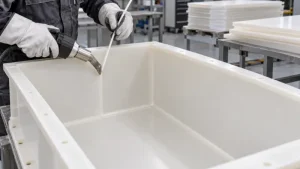
Welding PVDF sheet generally uses thermoplastic fusion methods rather than adhesives. The chosen method depends on sheet thickness, joint location, access, equipment, structural demand, and fabrication sequence.
| Welding method | Common use | Key controls |
|---|---|---|
| Hot-gas welding | Corners, attachments, repairs, and complex fabricated details | Clean gas, compatible rod, temperature, speed, pressure, and bead placement |
| High-speed hot-gas welding | Longer seams where a speed nozzle can be used | Nozzle condition, rod feed, preheat, travel consistency, and operator control |
| Extrusion welding | Thicker sheet and larger structural seams | Extrudate condition, preheat, preparation, bead geometry, and heat input |
| Heated-tool butt welding | Straight sheet or component joints with controlled alignment | Tool condition, temperature, pressure, alignment, timing, and cooling |
| Socket or butt fusion | PVDF pipework and selected nozzles or fittings | Compatible dimensions, facing, heating cycle, fusion pressure, and alignment |
Hot gas welding PVDF is versatile, but joint quality depends heavily on preparation and technique. PVDF butt welding can produce controlled straight joints when equipment and geometry allow. Extrusion welding may increase deposition rate on thicker structures, yet it does not eliminate the need for a qualified procedure.
Exact temperatures, pressures, travel speeds, and timing should follow the sheet manufacturer, welding-equipment supplier, and qualified procedure. Copying settings from another polymer or relying on one universal internet value can overheat the material, produce inadequate fusion, or distort the panel.
Prepare Edges and Surfaces Carefully
Cleanliness affects fusion. Dirt, oil, moisture, marker residue, oxidised surfaces, cutting debris, or unsuitable cleaning chemicals can reduce weld quality. Sheet and rod should be stored in a controlled condition and protected from shop contamination.
Joint edges need consistent geometry and close fit. Excessive gaps force the weld bead to bridge rather than fuse correctly. Poor alignment changes load distribution and may create local stress. The preparation method should avoid smearing contamination into the weld face.
Welding should begin soon after final preparation when the approved procedure requires it. Temporary clamps and fixtures must hold alignment without creating dents or excessive restraint. Tack welds need controlled spacing and should become part of the qualified sequence rather than random local heating.
Design Welded Joints Around Load Direction
Joint configuration influences strength, inspectability, and fabrication access. Butt joints, corner joints, T-joints, lap details, and nozzle connections carry loads differently. Weld volume alone does not guarantee a strong joint.
Sound PVDF tank design reduces peel and bending loads at welds wherever practical. Corners should transfer hydrostatic load into the adjoining panels and support system. Nozzles need reinforcement and enough spacing from corners or other discontinuities. Large cut-outs can weaken the wall even when the nozzle weld itself is sound.
Internal baffles, weirs, heating elements, mixers, and pipe supports create local loads. Their attachment points should be considered during structural analysis instead of added after the shell is fabricated. Vibration from pumps or agitators should not be transmitted directly into unsupported thermoplastic nozzles.
Use Structural Support Without Damaging the PVDF
Some tanks can be self-supporting within a validated design range, while larger or hotter vessels may require external steel or composite reinforcement. Frame design must account for panel deflection, thermal movement, corrosion, inspection access, and contact pressure.
Narrow metal edges can concentrate load against the sheet. Broad, smooth contact surfaces distribute pressure more evenly. Protective interfaces must remain chemically and thermally suitable, and they should not trap leaked chemicals where inspection is difficult.
Metal reinforcement should not be mistaken for permission to use an inadequately designed thermoplastic shell. The liner or inner tank still needs enough integrity to span supports, carry local loads, and remain leak-tight through thermal cycles.
Distinguish Solid PVDF Tanks From Dual-Laminate Construction
Solid PVDF tank fabrication uses PVDF as the primary shell material, sometimes with external reinforcement. Dual-laminate equipment uses a thermoplastic corrosion barrier bonded to a fibre-reinforced structural backing. These are different engineering systems.
Dual laminates can provide stiffness for large vessels while keeping PVDF at the wetted surface. Bonding requires a suitable backed or treated sheet, compatible resin system, controlled fabrication, and careful design at flanges and nozzles. Smooth standard sheet should not be assumed to bond reliably to a composite structure.
Repair methods also differ. Weld repair on a solid sheet tank is not the same as restoring a bonded corrosion barrier and structural laminate. Drawings and inspection records should clearly identify the construction type.
Control Distortion During Fabrication
Heat input can shrink or bow sheet panels. Welding long seams continuously in one direction may accumulate distortion. Balanced sequencing, appropriate fixtures, controlled bead size, and adequate cooling can help maintain geometry.
Over-restraint can create residual stress even when the finished tank looks square. Fabricators should follow an approved sequence for walls, floor, corners, reinforcements, nozzles, and attachments. Dimensional inspection should occur at defined stages rather than only after every joint is complete.
Inspect and Test Welded PVDF Tanks
Inspection begins before welding with verification of material identity, sheet condition, joint preparation, equipment status, and operator qualification. During welding, essential parameters and traceability should be recorded according to the project plan.
Visual inspection can identify surface contamination, irregular bead shape, undercut, incomplete coverage, overheating, cracks, misalignment, and other visible discontinuities. Visual acceptance alone cannot prove full fusion beneath the bead. Projects may therefore use procedure qualification, destructive sample testing, spark testing of suitable lined construction, leak testing, or hydrostatic testing as appropriate.
Test method and acceptance criteria must be agreed before fabrication. Pneumatic testing can store considerable energy and requires a dedicated safety procedure. Hydrostatic testing introduces structural load and needs correct support, staged filling, hold time, inspection, and controlled drainage.
Specify Fabrication and Quality Requirements Clearly
When comparing PVDF sheet suppliers, buyers should review grade traceability, dimensional capability, sheet condition, welding compatibility, certificates, packaging, and repeat-batch control. The selected PVDF sheet manufacturer should be able to identify the supplied grade and confirm which values are typical data rather than guaranteed specification limits.
PVDF sheet price varies with resin grade, thickness, sheet dimensions, order volume, certification, cutting, packaging, and fabrication requirements. Comparing price per sheet without normalising these factors can produce a misleading sourcing decision.
The request for quotation should include:
- Tank dimensions, working capacity, maximum fill level, and liquid density
- Process chemicals, concentrations, contaminants, and cleaning media
- Normal, maximum, minimum, and upset temperatures
- Internal pressure, vacuum, venting, and possible blocked-vent condition
- PVDF grade, sheet thickness, colour, and certificate requirements
- Nozzle sizes, locations, loads, connections, and mating pipework
- External frame, supports, anchors, lifting points, and installation surface
- Welding procedure, operator qualification, consumable traceability, and records
- Inspection, leak testing, dimensional acceptance, cleaning, and packaging
- Applicable design code, site standard, and expected service life
Drawings should distinguish wetted materials from structural materials. Notes such as “PVDF tank” are not enough to define grade, thickness, construction, supports, joints, nozzles, or acceptance testing.
Common PVDF Tank Fabrication Mistakes
- Selecting material from room-temperature chemical data while ignoring actual process temperature
- Choosing sheet thickness without long-term creep and hydrostatic loading
- Using unmatched sheet and welding rod grades
- Copying welding settings from PVC, PP, or another PVDF grade
- Placing heavy valves or pipe loads directly on unsupported nozzles
- Restraining thermal expansion with a rigid steel frame
- Adding baffles or equipment mounts after structural design is complete
- Accepting weld appearance without a defined qualification and test plan
- Confusing solid sheet fabrication with coated metal or dual laminate
- Changing the stored chemical without a new compatibility review
Frequently Asked Questions
Can PVDF sheets be welded?
Yes. PVDF is a melt-processable thermoplastic and can be joined using suitable fusion methods. The correct method and parameters depend on grade, thickness, joint design, equipment, and the qualified procedure.
Which welding method is best for PVDF sheet?
No single method is best for every joint. Hot-gas welding suits many corners and detailed attachments, extrusion welding is commonly considered for thicker structural seams, and heated-tool methods can suit controlled straight joints.
Can PVC welding parameters be used for PVDF?
No. Different polymers and PVDF grades have different processing behaviour. Use parameters approved for the exact material, welding method, equipment, and joint geometry.
How thick should a PVDF chemical tank be?
Thickness must be calculated from tank geometry, liquid depth and density, temperature, creep, support spacing, openings, joint efficiency, and applicable design criteria. Universal thickness recommendations would be unsafe.
Does a PVDF tank need external reinforcement?
Small validated designs may be self-supporting, while larger, taller, hotter, or more heavily loaded tanks may need reinforcement. The frame and thermoplastic shell must be designed together.
Is PVDF resistant to every acid and solvent?
No. PVDF resists many industrial chemicals, but compatibility depends on the chemical, concentration, temperature, mixtures, stress, and exposure time. Grade-specific data and testing may be necessary.
Can standard PVDF sheet be used for a dual-laminate tank?
Not automatically. Dual-laminate construction needs a sheet surface and backing system designed for reliable bonding to the structural composite. Confirm the sheet, treatment, resin, and fabrication procedure.
How are PVDF tank welds inspected?
Inspection may include material verification, parameter records, visual examination, dimensional checks, qualified sample testing, leak testing, or hydrostatic testing. The project specification should define methods and acceptance criteria.
Why do PVDF sheets distort during welding?
Local heating and cooling create shrinkage. Uneven sequencing, excessive heat input, poor fit-up, large beads, or over-restrained fixtures can increase panel distortion and residual stress.
What information does a PVDF tank supplier need?
Provide tank dimensions, chemical composition, temperature, liquid density, pressure or vacuum, nozzles, loads, grade, thickness, support design, welding requirements, inspection, documentation, quantity, and installation conditions.
Build the Specification Before Fabrication
Reliable thermoplastic tank fabrication begins with chemical, thermal, structural, and manufacturing requirements that agree with one another. PVDF’s weldability does not remove the need for engineering analysis, qualified operators, controlled procedures, and inspection.
JIAFUXIN supplies PVDF sheet and related fluoropolymer sheet materials for chemical-processing and fabricated-equipment projects. Review the wider chemical-processing material applications, then send the chemical conditions, sheet specification, dimensions, quantity, and documentation requirements for evaluation. Contact JIAFUXIN to discuss PVDF sheet supply or a drawing-based requirement.


